Ocular rosacea: when rosacea affects the eyes and eyelids
Ocular rosacea, also called eye rosacea, is rosacea that affects the eyes and eyelids. It typically causes dry, gritty, burning or red eyes, inflamed lid margins and blocked oil glands along the lashes, and it can appear with or without facial redness. Warm compresses and lid cleaning are the daily base of care; an eye doctor adds drops, ointments or tablets, and intense pulsed light (IPL) is being tested on the eyelid glands.
Researched and written by Seoul Rosacea editors. Editorially updated: .
What is ocular rosacea?
Rosacea is best known for redness of the central face, but it can also involve the eyes. The global ROSCO panel, which included ophthalmologists, lists eye signs among the features of rosacea, though not among those that diagnose it on their own.[1] The American Academy of Ophthalmology (AAO) notes that some people have skin rosacea with no eye symptoms, others have eye symptoms with no skin signs, and some have both (AAO, checked 24 October 2026). According to the American Academy of Dermatology (AAD), an estimated 50% of people with rosacea will have a flare-up that affects the eyes (AAD symptoms page, checked 24 October 2026).
| Feature | What it means |
|---|---|
| Lid margin telangiectasia | Visible small vessels along the eyelid margins; harder to see on darker skin |
| Blepharitis | Inflammation of the eyelid margin, most often from meibomian gland dysfunction |
| Conjunctivitis | Inflammation of the membrane lining the eyelids and the white of the eye, with redness and swelling |
| Keratitis | Inflammation of the cornea; it can cause defects and, in the most severe cases, vision loss |
| Anterior uveitis | Inflammation of the iris or the ciliary body |
The same panel lists better diagnosis of ocular rosacea as an unmet need and notes that dermatologists may often overlook it.[2]
Ocular rosacea symptoms
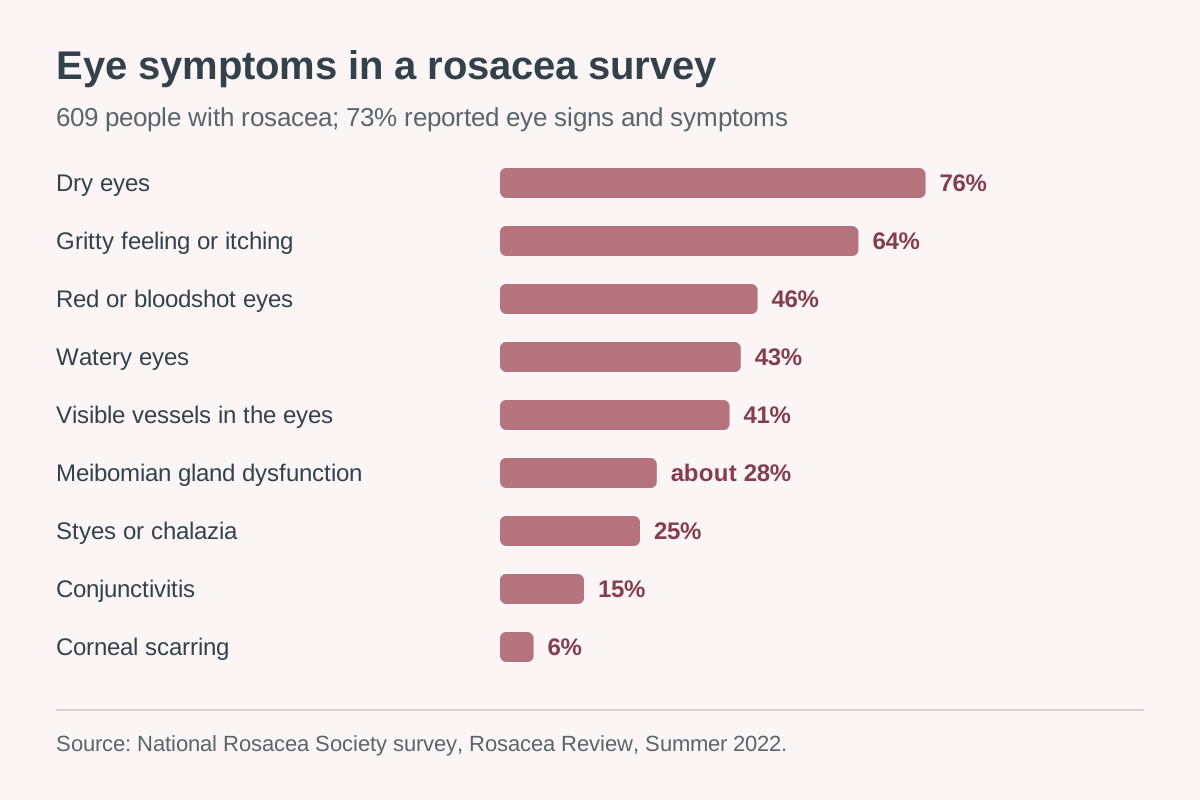
In a National Rosacea Society survey of 609 people with rosacea, 73% reported eye signs and symptoms (NRS Rosacea Review, Summer 2022, checked 24 October 2026). Dry eyes (76%) and a gritty, foreign-body feeling or itching (64%) led the list, and about half reported light sensitivity, burning or stinging. Fewer reported red eyes (46%), watery eyes (43%), visible vessels in the eyes (41%), meibomian gland dysfunction (about 28%), styes or chalazia (25%) and conjunctivitis (15%); 6% reported scarring of the cornea.
Look at the eyelids as well. The AAO lists redness and swelling of the lids and lash bases, clogged eyelid oil glands and a chalazion or stye (AAO), and the AAD adds honey-coloured crusts on the lashes and changes to eyesight (AAD symptoms page).
Why the eyelid oil glands matter
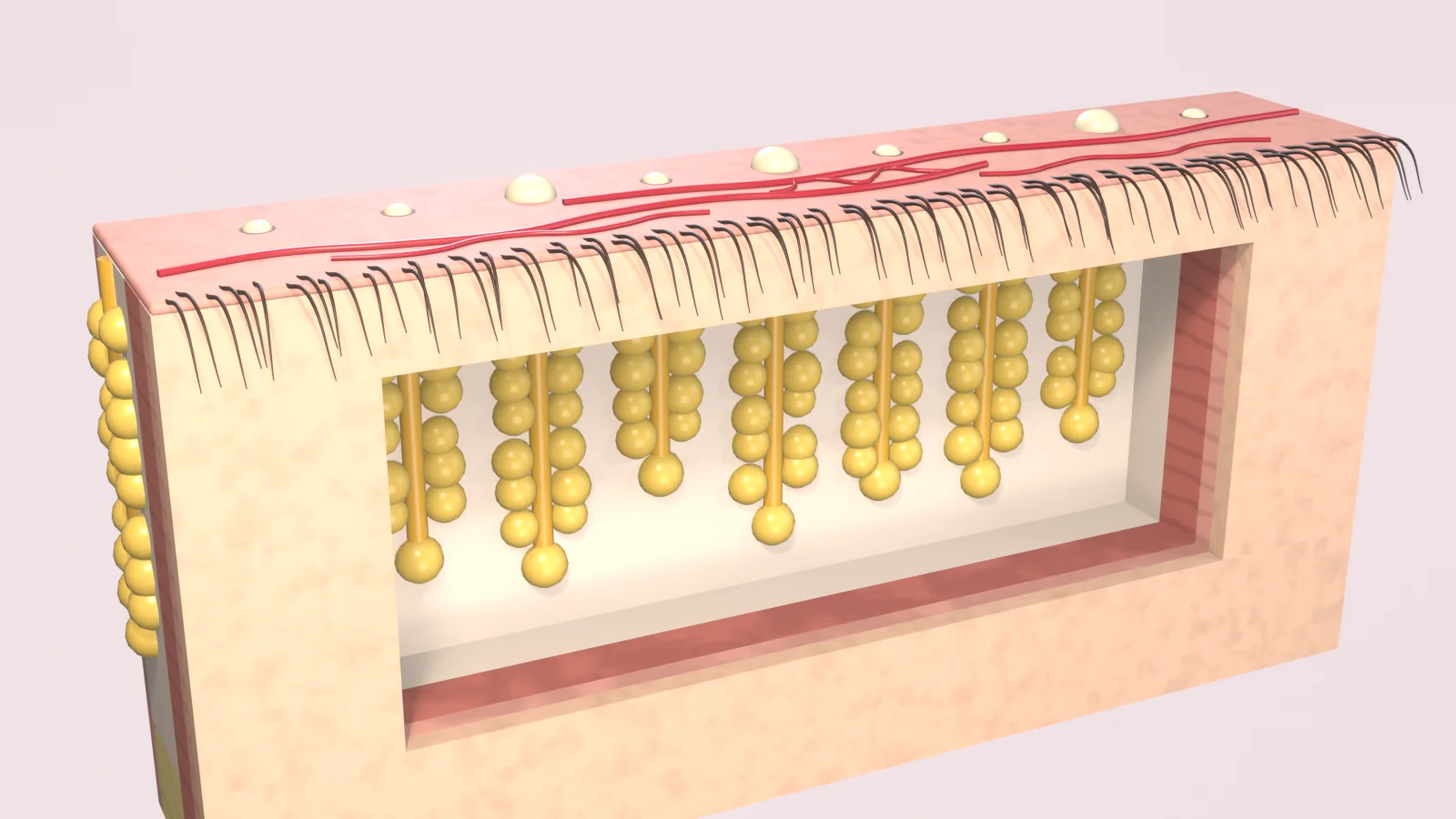
Many eye symptoms of rosacea start at the lid margin. The meibomian glands are the oil glands of the eyelids; in ocular rosacea their openings can block, the lid margin can show fine vessels, and the oil they release (meibum) changes in quality and amount. Meibomian gland dysfunction is the most common eye finding in people with ocular rosacea.[3]
An eye doctor can photograph these glands with infrared light (meibography). In a 2025 study of 30 people with ocular rosacea and 34 controls, gland loss averaged 46.0% in the lower lids against 18.4% in controls, and 31.4% against 20.0% in the upper lids.[4]
Who treats ocular rosacea?
Often both a dermatologist and an eye doctor. The 2017 ROSCO panel advised considering referral to an ophthalmologist for all but the mildest eye features, with lid hygiene and artificial tears used alongside medicines.[5] Its 2019 update names blepharokeratoconjunctivitis, sclerokeratitis, anterior uveitis and blepharoconjunctivitis as eye features that a dermatologist should refer to an ophthalmologist for treatment.[2] The AAD says a dermatologist may treat mild or moderate ocular rosacea or refer it, and that anyone whose eyesight is threatened is referred to an ophthalmologist at once (AAD treatment page, checked 24 October 2026).
A painful eye, blurred vision or sensitivity to light needs an urgent appointment. The NHS lists these, together with a red or gritty eye, as possible signs of keratitis in people with rosacea, which can be serious if not treated urgently (NHS, checked 24 October 2026).
A daily eyelid routine
Warm compresses and lid cleaning are the home part of treatment. The AAD describes them as usually done twice a day: the compress first, then the lashes (AAD treatment page).
- Warm compress. Rest a warm cloth or pad on your closed eyes for as long as your doctor recommends.
- Lid cleaning. With your eyes closed, gently clean along the lashes with a wet washcloth, an eyelid cleanser or a little baby shampoo mixed with warm water.
- Artificial tears. Use them to keep the eyes moist through the day.
- No drops for bloodshot eyes. The AAO warns that eye drops sold for bloodshot eyes can make ocular rosacea symptoms worse.
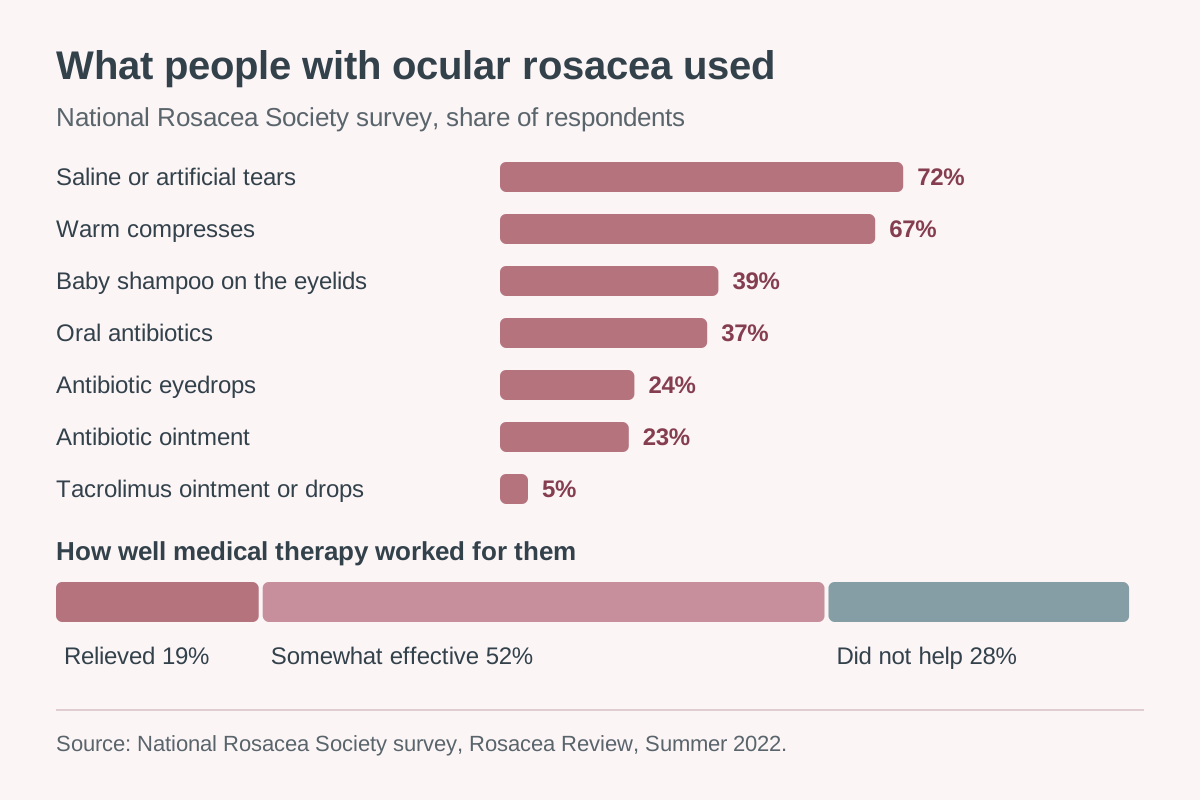
These are also the measures people use most. In the NRS survey, 72% of respondents with ocular rosacea used saline or artificial tears, 67% warm compresses and 39% baby shampoo on the eyelids. Medical therapy relieved their eye signs and symptoms for 19%, was somewhat effective for 52% and did not help 28%.
If you are travelling to Seoul with rosacea, pack artificial tears and any prescribed eye ointment in your hand luggage.
Ocular rosacea treatment: drops, ointments and tablets
Prescription treatment comes from the eye doctor or dermatologist. The AAO lists steroid eye drops and ointments to reduce redness and swelling, antibiotic tablets or ointments for eye infection and skin rosacea, and artificial tears (AAO). The AAD adds antibiotic eye treatment to reduce bacteria and soften debris on the lashes, ciclosporin eye drops used twice a day for burning, stinging and light sensitivity, omega-3 supplements for dryness, and low-dose doxycycline or another antibiotic by mouth (AAD treatment page).
Use only the eye product you were prescribed: the AAD warns that antibiotics made for the skin can be harmful when used on the eyes. The evidence grades for these options are in the treatment guide.
IPL for ocular rosacea: what a controlled trial found
Intense pulsed light was first used in dermatology for vascular and inflammatory conditions.[6] It has also been widely studied in ophthalmology for dry eye and meibomian gland dysfunction. A 2026 systematic review of 20 studies of pulsed dye laser and IPL in rosacea reports that, in ocular rosacea, IPL reduced lid-margin vessels and improved the expression of gland oil.[7] A second 2026 review notes that the ways IPL might act on the eyelids remain incompletely established and that high-quality randomised trials are still limited.[6]
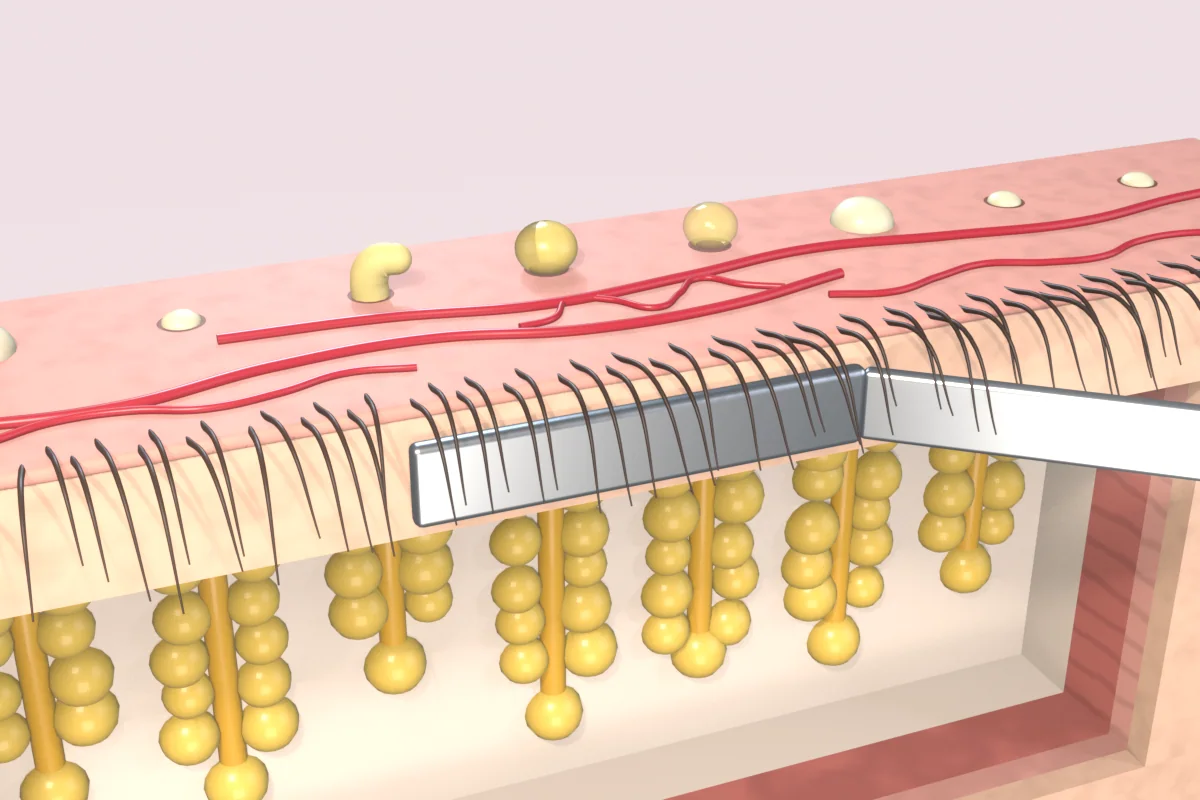
In meibomian gland expression the eyelid is massaged so that the glands release their secretion. In the trial below, both eyes had expression before each IPL or sham session, and the secretion was scored from toothpaste-like through cloudy to clear liquid.[3]
One IPL session in the 2025 eyelid trial
Each treatment began with gland expression and ended with the light pulses.[3]
Step 1 of 6: Numbing drop and gland expression
An anaesthetic drop went into the eye, and the eyelid glands were massaged and expressed with a flat-tipped steel instrument.
Step 2 of 6: Numbing cream
Almost 1 hour
Anaesthetic cream covered the lower-eyelid area, from the nose side to the temple side, and the forehead. It was washed off and a layer of ultrasound gel applied.
Step 3 of 6: Eye cover
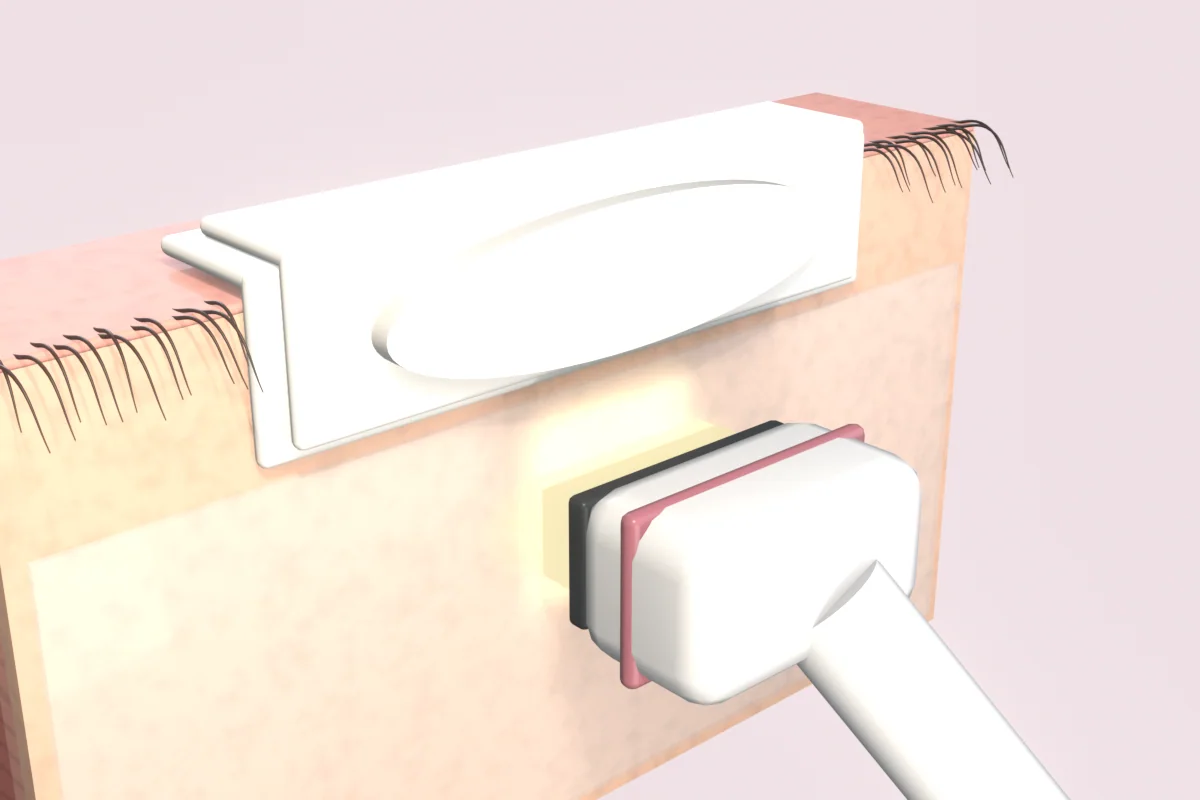
Two folded pieces of moist gauze were laid on the eyelids, with a ceramic patch on top.
Step 4 of 6: Light pulses
Pulses were placed side by side across the treatment area, overlapping by no more than 10%, at 9 to 15 J/cm² chosen by skin type. The comparison eye received sham pulses from a filtered probe that looked identical.
Step 5 of 6: Ointment at night
Erythromycin ointment went on the upper and lower lid margins once a night from the first follow-up visit.
Step 6 of 6: Repeat
2 weeks ± 3 days apart
Four treatments in total.
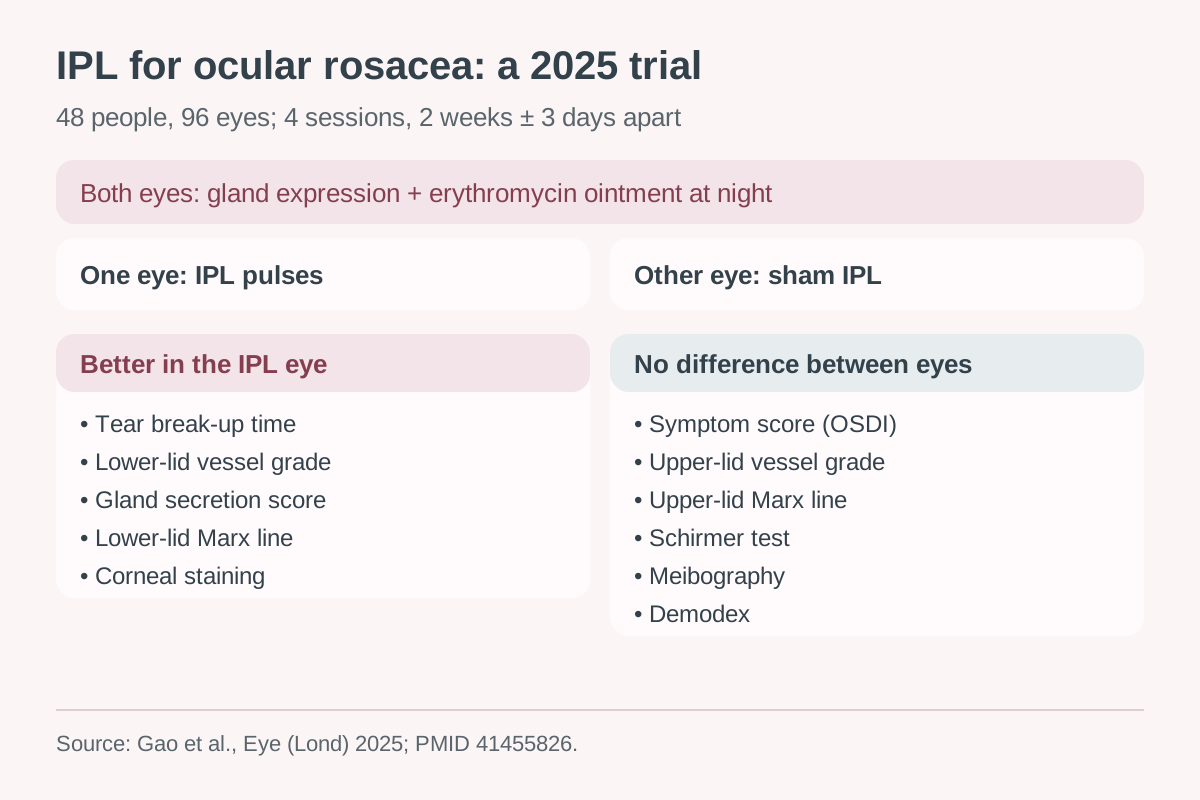
The trial, at Peking University First Hospital, enrolled 48 people with ocular rosacea. Each person had IPL on one eye and sham IPL on the other, and both eyes had gland expression and erythromycin ointment. After four sessions, the IPL eyes did better on tear-film stability (tear break-up time), lower-lid vessels, gland secretion, the lower-lid Marx line and corneal staining. Symptom scores fell in both groups with no difference between them, and upper-lid vessels, the upper-lid Marx line, Schirmer tear tests, gland imaging and Demodex did not differ either. The gain in tear break-up time was under one second, and no adverse events were reported.[3]
Caring for the skin and the eyes together
The AAO lists the usual rosacea triggers on its ocular rosacea page: heat, sun, wind and cold, strenuous exercise, alcohol, spicy food, hot coffee or tea, and stress. A diary of your own rosacea triggers covers the eyes as well as the face.
Facial redness, bumps and visible vessels each have their own first-line treatments, and several can be used at once.[5] Facial IPL and vascular lasers are covered in the lasers and light guide. While an eye doctor looks after the eyes, a dermatologist can treat the redness and bumps on the face.
Can ocular rosacea cause blindness?
In the most severe cases, yes. Keratitis, inflammation of the cornea, can cause corneal defects and, at its most severe, loss of vision.[2] In the NRS survey, 6% reported scarring of the cornea.
Can you have ocular rosacea without skin symptoms?
Yes. The AAO notes that some people have ocular rosacea with no skin symptoms, while others have skin rosacea with no eye symptoms.
Can children get ocular rosacea?
Yes. A 2026 review of the records of 31 children aged 16 or under found that burning or stinging was the most common first complaint (58.1%), the cornea was involved in 71.0% of eyes, and skin signs were present in 54.8% of the children. Diagnosis took 13.2 months on average, and three children had first been treated for herpetic keratitis.[8]
Is ocular rosacea contagious?
No. Rosacea is not contagious and is not caused by poor hygiene, although lid cleaning can reduce eye symptoms.
References (8)
Author, title and journal details follow each paper’s PubMed record at the U.S. National Library of Medicine.
- Tan J, Almeida LM, Bewley A, Cribier B, Dlova NC, Gallo R, et al. Updating the diagnosis, classification and assessment of rosacea: recommendations from the global ROSacea COnsensus (ROSCO) panel. Br J Dermatol. 176(2):431-438. PubMed: 27718519
- Schaller M, Almeida LMC, Bewley A, Cribier B, Del Rosso J, Dlova NC, et al. Recommendations for rosacea diagnosis, classification and management: update from the global ROSacea COnsensus 2019 panel. Br J Dermatol. 182(5):1269-1276. PubMed: 31392722
- Gao Y, Huang M, Dong W, Li Y, Cheng Y, Yang F, et al. Drugs with meibomian gland expression alone versus combined with intense pulsed light in ocular rosacea: a randomised controlled study. Eye (Lond). 40(4):521-528. PubMed: 41455826
- Gokcinar NB, Karabulut AA. Quantitative infrared meibography for ocular rosacea: lower eyelid meibomian gland loss as a diagnostic marker. BMC Ophthalmol. 26(1):4. PubMed: 41318445
- Schaller M, Almeida LM, Bewley A, Cribier B, Dlova NC, Kautz G, et al. Rosacea treatment update: recommendations from the global ROSacea COnsensus (ROSCO) panel. Br J Dermatol. 176(2):465-471. PubMed: 27861741
- Yan J, Chen W, Li J. Intense pulsed light as a multi-target intervention paradigm for refractory ocular surface diseases: a review. Eye Vis (Lond). 13(1). PubMed: 42816895
- Finney OS, Soliman J, Choi M, Zachary CB, Lee OL, Kelly KM. Pulsed Dye Laser and Intense Pulsed Light Therapy for Cutaneous and Ocular Rosacea: A Systematic Review. Lasers Surg Med. 2026 Aug 6. PubMed: 42561123
- Akgun Z, Bulut Tarlabolen O, Barut Selver O, Palamar M. Recognizing Paediatric Ocular Rosacea: Clinical Spectrum, Diagnostic Clues, and Treatment Outcomes. Ocul Immunol Inflamm. 2026 Sep 18:1-7. PubMed: 42757848