Demodex mites on the face: when face mites matter for rosacea
Demodex mites are microscopic mites that live in the hair follicles and oil glands of the face, and healthy adults carry them in small numbers. They matter when the numbers climb: more than 5 mites per square centimetre is counted as high, and people with rosacea are more likely to have a Demodex infestation and a higher mite density. A dermatologist can count them from a skin sample or look for them under UV light, and ivermectin cream lowers mite density, although mites can return after treatment ends.
Researched and written by Seoul Rosacea editors. Published · Updated
What are Demodex mites?
Two species live on human skin. Demodex folliculorum lives in the hair follicles and Demodex brevis in the oil (sebaceous) glands; in small numbers they are usually harmless, and an overgrowth has been linked to several inflammatory skin conditions.[4] A 2025 Korean study sums up the background: the mites are found on the skin of healthy adults at a prevalence of 100%, at a density of 5 mites per square centimetre or fewer.[2]
When the mites overgrow, the condition is called demodicosis, and it can cause facial redness, irritation, itching and inflammation. The diagnosis rests on counting how many mites are on the skin surface.[2]
Do face mites cause rosacea?
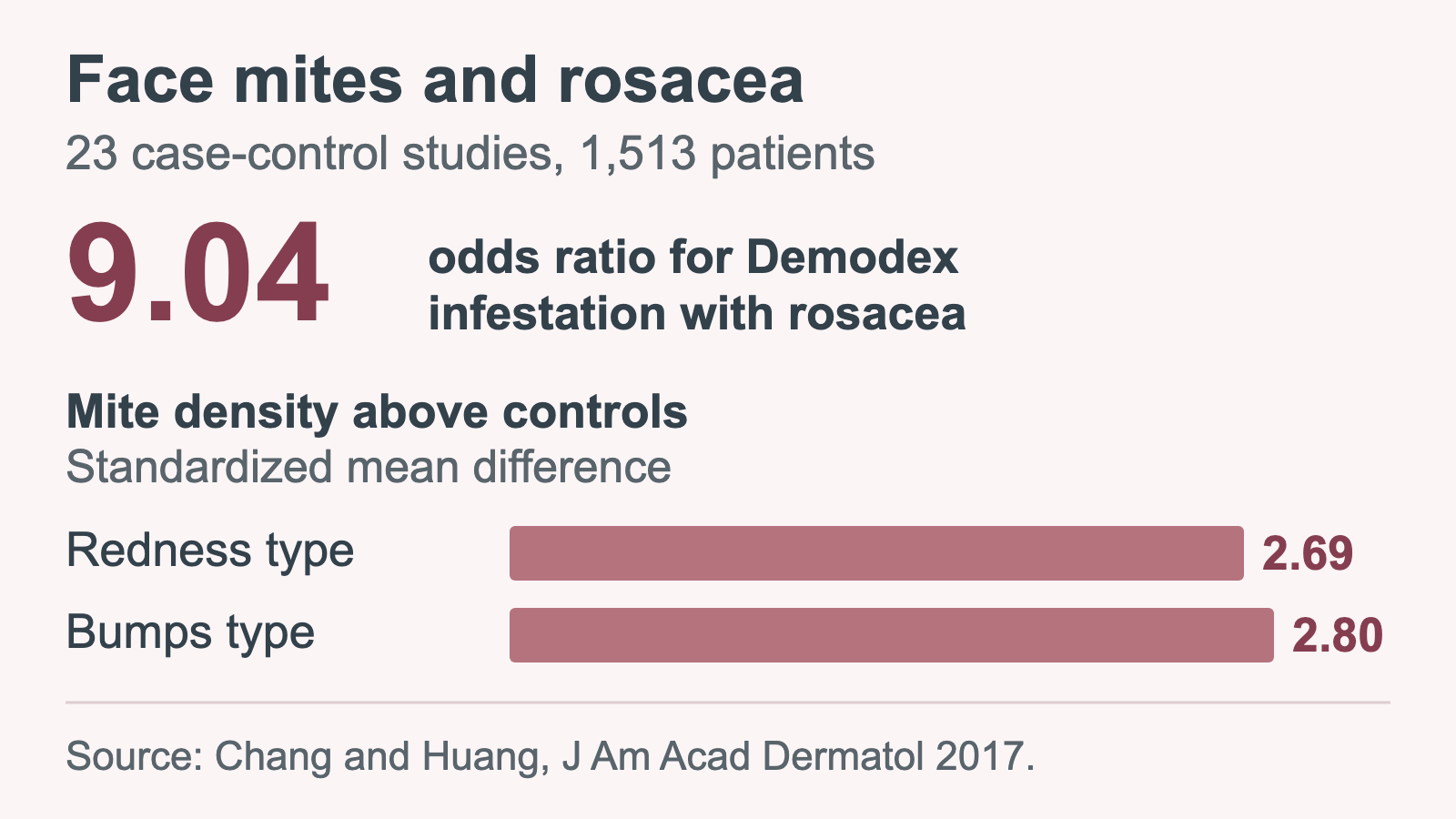
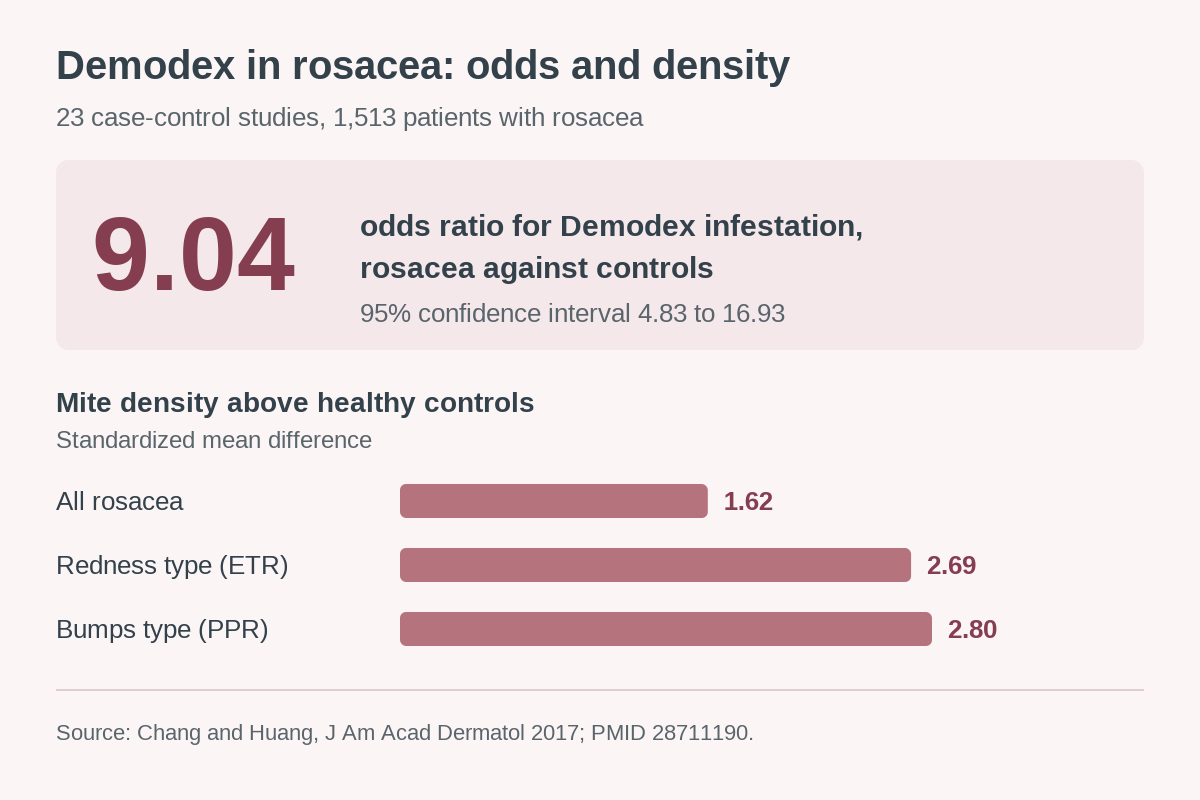
They are linked with it, but a cause has not been shown. A meta-analysis of 23 case-control studies with 1,513 patients with rosacea found that people with rosacea had about nine times the odds of a Demodex infestation (odds ratio 9.04; 95% confidence interval 4.83 to 16.93) and a higher mite density than people without rosacea. Density was higher in both the redness type (erythematotelangiectatic rosacea) and the bumps type (papulopustular rosacea). Results varied widely between studies, and case-control studies cannot prove that mites cause rosacea.[1]
The mites are one part of a wider picture. A 2025 review of the skin microbiome describes rosacea as driven by immune dysregulation, genetic predisposition, a weakened skin barrier and microbial imbalance, with Demodex folliculorum among the species that increase in rosacea, alongside Staphylococcus epidermidis and Bacillus oleronius.[5] The everyday factors that set off flares are in the rosacea triggers guide.
When do face mites become a problem?
Doctors look at density rather than presence. A study of 1,124 patients with facial redness, measured at two Korean referral hospitals between 2016 and 2023, classed more than 5 mites per square centimetre as a high density. In the main group of 1,024 patients, 24.9% had a high density; in the second group of 100 patients from the other hospital, 45.0% did.[2]
Most of these patients reported itching (80.9% of the main group), 42.4% reported flushing and 21.8% burning or stinging. Older age and a positive patch test were linked with a high mite density, and skin problems elsewhere on the body with a lower one. The computer model the study built picked up the central face, where the mites multiply most, and the fine-scaled bumps and tiny pustules typical of demodicosis.[2]
How is Demodex tested?
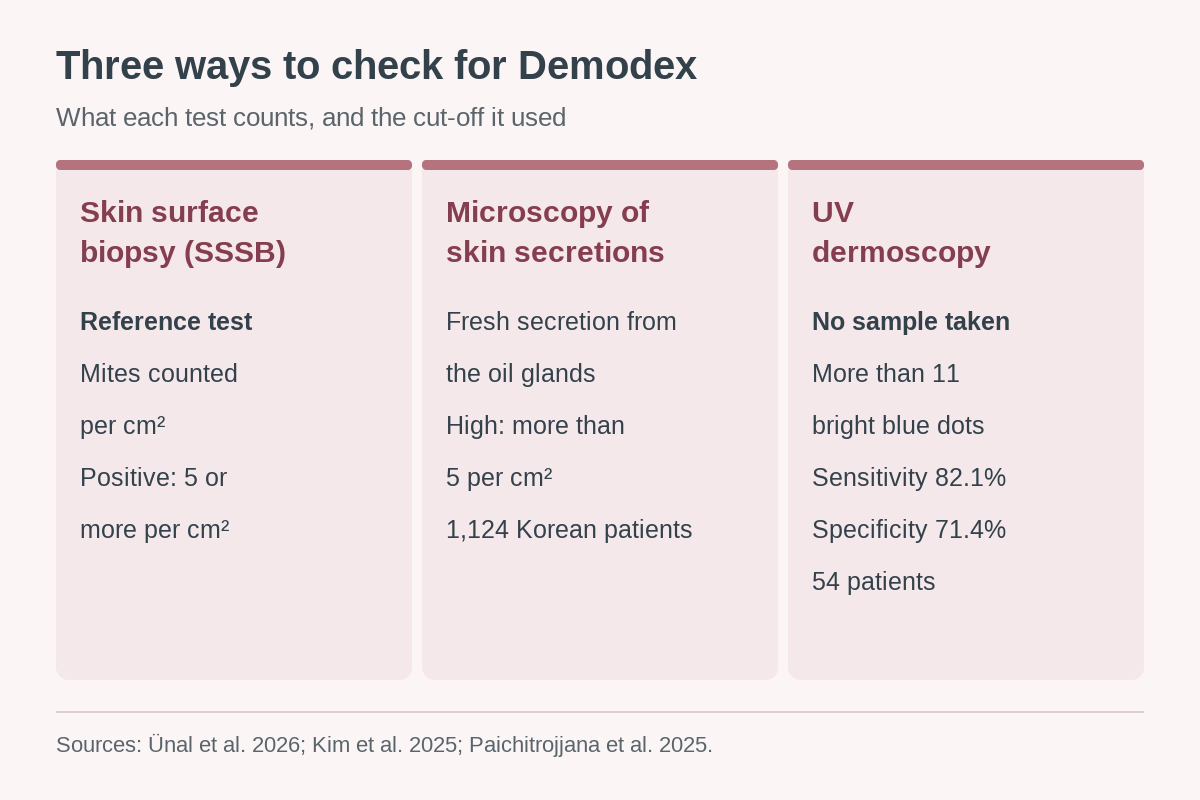
There are two standard ways to count the mites: a standardized skin surface biopsy (SSSB), which takes a sample from the skin surface and counts mites per square centimetre, and direct microscopy of fresh secretions from the oil glands. Both are semi-invasive, can be uncomfortable, and depend on the skill of the person doing them.[2] The treatment studies below counted 5 or more mites per square centimetre as Demodex-positive.[4]
UV dermoscopy takes no sample. Under ultraviolet light the skin shows fluorescent dots, and in a 2026 study of 54 patients with rosacea or demodicosis, examined with both UV dermoscopy and SSSB from the same area of the face, the number of bright blue dots rose with the mite count. More than 11 bright blue dots picked out Demodex-positive skin with a sensitivity of 82.1% and a specificity of 71.4%. Orange dots were not related to mite density.[3]
Judging mite density from photographs is hard. In the Korean study, 21 dermatologists and dermatology residents judged mite density from facial photographs and clinical details; their accuracy was 63.7% on their own and 70.6% with the computer model’s score in front of them. The model was tested only on Korean patients with skin types III and IV, and it did less well on the second hospital’s patients.[2]
What treatment does to mite numbers
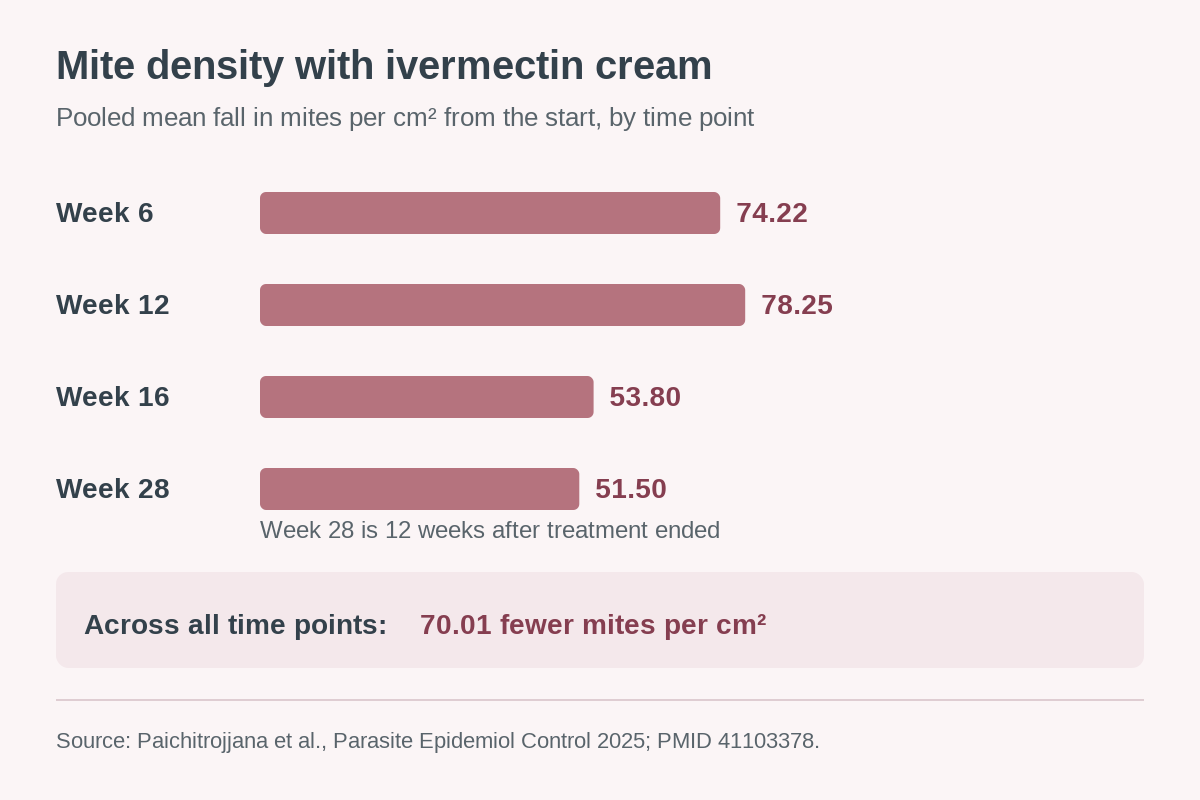
A 2025 meta-analysis reviewed five studies of ivermectin cream with 180 participants, most of them with the bumps type of rosacea, and mite counts fell in every study. In its pooled time-point estimates, counts were down by a mean of 74.22 mites per square centimetre at week 6, by 78.25 at week 12 and by 53.80 at week 16, and were still 51.50 lower at week 28, 12 weeks after treatment had ended; across all time points the mean fall was 70.01. Those estimates rest mainly on one study with complete data. In one study, 80% of the patients who tested positive before treatment were negative at week 16.[4]
Mites can come back. In one included study they were detected again in 63% of patients by week 28, and in another, 45.2% had a rosacea relapse a median of 140 days after treatment. Side effects were mild and limited to the skin, mainly stinging, burning and itching in the first weeks. The studies were small, most had no control group, and their results varied widely.[4] Creams, tablets and lasers for each feature of rosacea are compared in the treatment options guide.
What to ask at a dermatology appointment
- Could mites be part of this? Fine scaly bumps or tiny pustules on the central face are the features the Korean study’s model linked with demodicosis.
- Which test will you use? A skin surface biopsy or gland-secretion sample gives a count; UV dermoscopy gives a quick read without a sample.
- Will you recheck after treatment? Mites can return once treatment stops, so ask whether a repeat count is planned.
- Are my eyelids involved? Demodex is also implicated in blepharitis; eyelid symptoms are covered in the guide to ocular rosacea.
If you are in Seoul, bring the questions to a dermatologist who treats rosacea, together with a list of the creams you have already used.
Does everyone have face mites?
Nearly every adult does. The Korean study cites a prevalence of 100% in healthy adults, at a density of 5 mites per square centimetre or fewer.[2]
What is the difference between Demodex and demodicosis?
Demodex is the mite; demodicosis is the skin condition that follows when the mites overgrow, with redness, irritation, itching and inflammation of the face.[2]
Can face mites affect the eyes?
Yes. Demodex infestation is implicated in blepharitis, where it contributes to eyelid inflammation and dysfunction of the eyelid oil glands.[4]
Do face mites come back after treatment?
They can. In the ivermectin studies, mites were detected again in 63% of patients 12 weeks after a course ended in one study, and in another, 45.2% had a rosacea relapse after a median of 140 days.[4]
Is rosacea caused by poor hygiene?
No. The NHS rosacea page (checked 1 November 2026) states that rosacea is not caused by poor hygiene and is not contagious, and the mites live on healthy skin too.[2]
References (5)
Author, title and journal details follow each paper’s PubMed record at the U.S. National Library of Medicine.
- Chang YS, Huang YC. Role of Demodex mite infestation in rosacea: A systematic review and meta-analysis. J Am Acad Dermatol. 77(3):441-447.e6. PubMed: 28711190
- Kim J, Lee YN, Boo J, Oh I, Lee C, Lee JH, et al. Artificial intelligence-assisted prediction of Demodex mite density in facial erythema. Sci Rep. 16(1):456. PubMed: 41345235
- Ünal E, Yücel MB, Yiğit M, Yaman O, Ertaş R, Akay BN. Detection of Demodex in rosacea: standardized skin surface biopsy vs. ultraviolet dermoscopy. Clin Exp Dermatol. 51(8):1400-1405. PubMed: 41739824
- Paichitrojjana A, Khuancharee K, Paichitrojjana A. Efficacy of topical Ivermectin in controlling human Demodex infestation: Evidence from systematic review and meta-analysis. Parasite Epidemiol Control. 31:e00461. PubMed: 41103378
- Asees A, Sadur A, Choudhary S. The Skin Microbiome in Rosacea: Mechanisms, Gut-Skin Interactions, and Therapeutic Implications. Cutis. 116(1):20-23. PubMed: 40875939